


Why This One Works When Others Did Not
Every feature below came from understanding exactly why single-panel solar banks disappoint. This is a direct response to those failures.
4 solar panels, not 1
The reason cheap solar banks feel like gimmicks is their single small panel. Four panels produce four times the current. The difference in real-world charging performance is not small.
Based on category research from r/preppers
42,800mAh vs 10,000-20,000mAh
Most solar banks at this price point hold enough for 2-3 phone charges. SUDROV holds 10-14, which covers the whole family through a week-long outage.
Confirmed on product listing
Every cable built in, nothing to lose
Lightning, USB-C and Micro-USB are permanently attached. Other banks make you carry separate cables, which get lost before you need them most.
"Charging cables are built-in which is a huge plus" — Amazon reviewer
Waterproof, dustproof, shockproof
Sealed ports, armored rubber corners, and a shockproof chassis that has survived real drops and water submersion in owner testing over multiple years of use.
From creator testimony, 2 years, multiple drops and water exposure
3-mode flashlight including SOS
Dual bright LEDs with steady, strobe and SOS emergency modes. In a power outage, this is the flashlight you want in your hand. It runs off the same solar-charged battery.
4 ways to recharge the bank itself
Solar panels, built-in input cable, USB-C input and Lightning input. When one method is not available, another is. You are never stuck with a dead bank and no options.
Confirmed on product image ("4 Recharge Ways")
How It Stacks Up
This is the specific difference between a solar bank that ends up plugged in and one that works on its own.
| Feature | SUDROV Solar Power Bank | Typical single-panel bank | No backup power |
|---|---|---|---|
| Solar actually recharges the bank in sunlight | |||
| Capacity for a full week of family use | |||
| 5 simultaneous device outputs | |||
| Every cable built in, nothing extra to carry | |||
| Rugged, waterproof and shockproof | |||
| SOS emergency flashlight mode | |||
| Price | $14.99 | $25-$60+ | $0 now, much higher later |
Partial icon indicates feature present but with significant limitations. Competitor capacity and price ranges based on category research at time of publishing.
Everything You Get for $14.99
- SUDROV Solar Power Bank (42,800mAh)
- 4 high-efficiency solar panels that actually charge in sunlight
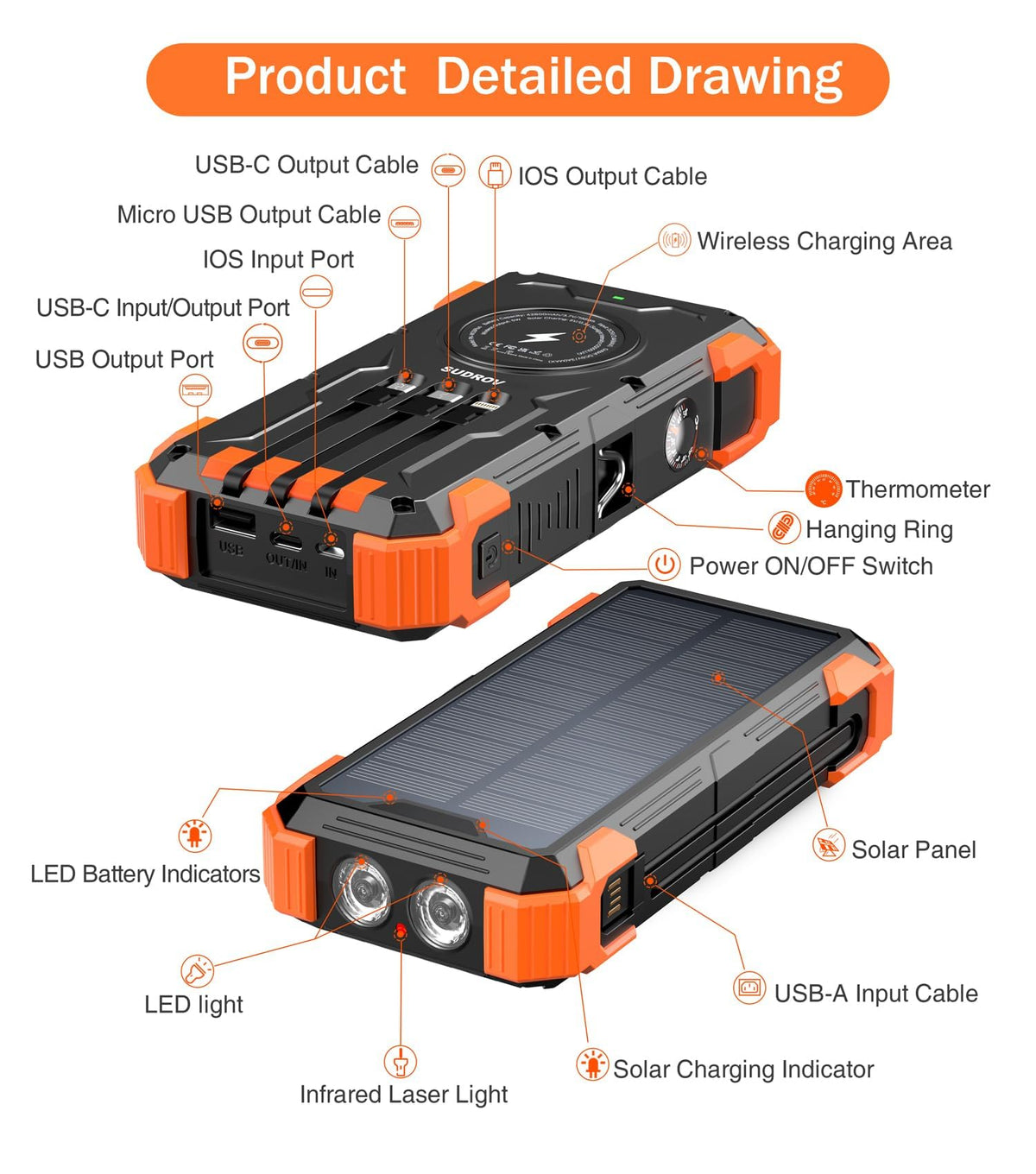
- 5 simultaneous outputs with Lightning, USB-C and Micro-USB cables built in
- Wireless charging pad for Qi-compatible phones
- Dual LED flashlight with steady, strobe and SOS modes
- Thermometer, red laser pointer and carabiner hook
- 4 ways to recharge the bank itself
- Waterproof, dustproof and shockproof rugged construction
90-day money-back guarantee. Not fully satisfied? Full refund, no questions.
Honest Answers to Real Questions
Including the one you are probably already thinking.
I bought a solar power bank before and the solar never worked. Why would this be any different?
That experience is the norm with single-panel solar banks, not a defective unit. A single small panel produces 1-2 watts in bright sunlight, which is not enough current to meaningfully charge a 10,000 or 20,000mAh battery before dark. So the indicator light blinks, nothing really happens, and you plug it in.
SUDROV runs four panels. The combined output is enough to make a visible difference across a full sunny day. It will not charge from empty to full in one afternoon, but it will restore meaningful capacity, which is exactly what single-panel banks cannot do. If you leave it in a south-facing window from morning to evening, you will see the battery indicator move.
Does the solar work on cloudy days?
Solar output drops with cloud cover. On a heavily overcast day, you will see much less charging current than on a bright sunny day. On a partly cloudy day, the panels will still contribute some charge. This is true of all solar devices.
That is why SUDROV includes four input methods, not just one. If the sky is not cooperating, use the built-in USB-A input cable, USB-C input port or Lightning input port to charge it from any source. The solar is a genuine recharge method on sunny days, not a replacement for all others.
How many devices can I charge at the same time?
Five simultaneously, using any combination of the Lightning cable, USB-C cable, Micro-USB cable, USB-A output port and USB-C output port. The wireless charging pad operates in addition to these for a sixth device. For a family of four using phones plus a walkie-talkie or radio, this covers the whole group at once.
The built-in cables on other banks are too short to be useful. Is that the case here?
The built-in output cables are designed for close-proximity charging, meaning you set the device next to the power bank rather than across the room. For most emergency and on-the-go use cases, this works well. If you need a longer run, the USB-A and USB-C output ports accept any standard cable of your preferred length.
Is it actually waterproof?
Yes. The construction is waterproof, dustproof and shockproof. Ports are sealed, the casing is sealed, and the rubber-armored corners absorb drops. Real-world use cases backed by owner testimony include camping trips with rain exposure, creek-side use, and multiple drops on hard surfaces over two-plus years of regular use. This is not a "splash-resistant" marketing claim.
Can it charge a laptop?
Yes, for laptops that charge via USB-C. The USB-C output port at 15W will charge a USB-C laptop, though more slowly than a dedicated wall charger. For emergency use, keeping a laptop at working charge is achievable. This does not apply to older laptops that use a proprietary charging connector.
How long does it take to fully charge the bank itself?
From a wall outlet using the built-in cable or USB-C input, expect 6-10 hours for a full charge given the 42,800mAh capacity. Via solar in direct sunlight, expect the panels to add meaningful charge across a full sunny day, with full solar charge taking multiple days. The practical recommendation is to keep it charged via wall outlet when at home, then rely on solar to extend its range when off-grid.
Can I keep one in my car for emergencies?
Yes. The rugged, shockproof construction handles vehicle environments well. Store it in the glove compartment or trunk. In sunlight through the car window, the solar panels will slowly top it up while parked. This is the setup recommended by several of the creators who tested it: one for your go-bag, one for the car, one for the home emergency kit.
What is the return policy?
90-day money-back guarantee. If you are not fully satisfied for any reason within 90 days of purchase, contact us for a full refund. No questions asked.
How long does shipping take?
Orders are processed in 1-2 business days and delivered within 5-10 business days after processing. You will receive a tracking number once your order ships.
1,800+ Families Already Have One
4.8 out of 5 stars across verified purchases
"Solar actually works. Left in window for two days and it stayed charged all week camping."
"Survived a creek drop and kept working. Waterproofing is not marketing. This thing is tough."
"Kept phones charged for three days during the ice storm outage. The built-in cables were a game changer."
"Got three. One for each car and one for the house kit. The SOS flashlight is genuinely bright."
"First solar bank I've owned where the solar actually contributed. Not a gimmick. Real difference."
"Husband is former Navy and very hard to impress with gear. He said this is the one to keep in the vehicle. High praise."
Stop Owning a Solar Bank That Needs a Socket
The first solar bank that actually recharges in sunlight. 42,800mAh of capacity. Every cable built in. $14.99.
90-Day Money-Back Guarantee